Healthcare
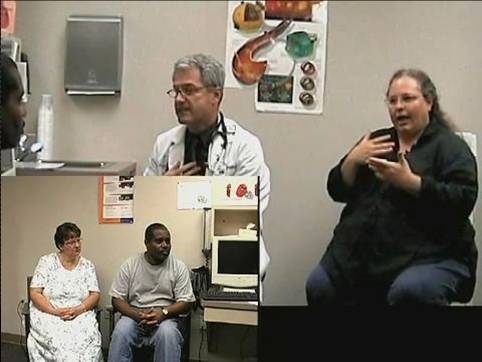 Healthcare interpreters may work in a variety of healthcare settings: hospitals, clinics, mental health and substance abuse facilities, private physicians’ offices, rehabilitation centers, domestic violence programs, and nursing homes. At times, interpreters may encounter the interface of healthcare and legal interpreting, for example, in work with forensic services. In addition, more and more healthcare interpreting is performed as a video remote service.
Since few undergraduate interpreting programs offer a focus on healthcare interpreting, practitioners interested in working in this setting pursue specialized training through workshops, online instruction, and mentorship. Certification and several years of general interpreting experience lay a strong foundation for a specialization in healthcare interpreting.
Healthcare Interpreting Fellowship
The Healthcare Interpreting Fellowship is a field-based induction process for nationally certified interpreters with three or more years interpreting experience who seek to build or enhance their healthcare interpreting practice. Inductees will have the benefit of practicing with experienced healthcare interpreters trained to provide supervision. The Healthcare Immersions have reached their maximum capacity for the 2015 events. Thank you for your interest, and we hope that funding will be made available again allowing this project to continue.
Download complete program description here.
Application Process:
Applicants must have national interpreter certification, plus a minimum of 3 years interpreting experience. Evidence of training in medical terminology and/or anatomy and physiology is preferred. Familiarity with Demand-Control Schema and/or Role-Space is helpful but not required.
The Fellowship Project is now closed to any new participants. Thank you for your interest. We hope that funding will be made available again allowing this project to continue.
Program costs: $250 commitment fee once accepted into the program
Watch a one-hour NCIEC Webinar explaining field-based induction.
Healthcare Immersion
Facilitated by Karen Malcolm and Nigel Howard, this four-day intensive course will offer application of anatomy and physiology in American Sign Language, with an emphasis on classifiers, specialized terminology used in medical settings, and ethical decision-making strategies especially for medical settings. To optimize learning, the program is offered at a hospital. Participants will analyze and practice interpreting discourse in both classroom and clinical settings. Class time will be interactive and hands-on, with lots of time for practice and feedback in a safe, supportive environment.
Registration fee is $250.
(Note that we are no longer accepting registrations for either program. If you wish to be added to a waiting list, please email the CATIE Center at St. Catherine University.)
Identification of effective practices for sign language interpreters working in the healthcare setting began during the 2005-2010 grant cycle through the efforts of the CATIE Center at St. Catherine University and the Regional Interpreter Education Center at Northeastern University. The team developed a concept map (below) for eight instructional modules addressing both the common core and distinctive features of medical and mental healthcare interpreting. Online instruction on ethics in healthcare interpreting was offered in 2010. The team also developed guidelines for infusing healthcare interpreting content into interpreting education program curricula.
A new Teaching Module for the Classroom, developed in collaboration with the National Interpreter Education Center, called Here’s to Your Future Health: Infusing Healthcare into Interpreter Education Programs is a 6-10 hour customizable module on the topic of interpreting in healthcare settings for interpreters-in-training. The module includes video testimonials from healthcare interpreters, role-play activities, and samples of two modules from the CATIE Center focused on the cardiovascular system and healthcare discourse. For more information, visit
http://www.interpretereducation.org/teaching/classroom-modules/.
Currently, the CATIE Center leads the efforts of the NCIEC healthcare interpreting initiative including coordination of the Healthcare Immersion Program and Healthcare Interpreting Fellowships.
Download Healthcare Interpreting documents:
Concept Map for Mental Health/Medical Interpreting Education (2008)
Interpreting in Healthcare Settings Annotated Bibliography (2014)
Interpreting in Healthcare Settings Annotated Bibliography – Excel spreadsheet format (2014)
Medical Interpreting ASL-English Domains and Competencies (2008)
Towards Reflective Practice: Case Studies for Interpreting in Healthcare Settings (2014)
For additional sources of information on Healthcare Interpreting for interpreters, educators, patients, and providers, visit Resources.